During the actual filming process I was resigned to an
assistant role as I was the group’s editor so I didn’t have a crucial role in
this part of the project. When we were on location I helped to set up the
equipment and set for the interviews, I tended to spend more time helping out
the people who were working on sound as most of them weren’t well practised in
that area. So for the most part I took a backseat in the production phase as
there was little for me to do, one role I did find myself in multiple times
while we were in Liverpool was as the group organiser because besides from
Emily Spokes our Producer my group were a bit of a rabble at times and needed a
forceful hand to get them to appointments on time.
Thursday, 20 February 2014
Liverpool Production
Upon arriving in Liverpool we were a little apprehensive as
we only had one solid meeting arranged and our entire idea hinged upon it.
Luckily John Finigan and Steve Barton of the Liverpool Homeless Football Club
were fully on board with our idea after hearing it in more detail from us by
the end of the meeting we had a full schedule of interviews and appointments,
we had also acquired permission to any online footage that they featured in as
they held all rights to it.

Sunday, 16 February 2014
Liverpool Documentary - Pre-production meetings
 Over the last two weeks my group and I have had several
meetings in which we discussed ideas, approaches and attempted to make contact
with people relating to our ideas. After several discussions we have decided upon
the idea of making a documentary on Liverpool’s homeless football club, this
idea stemmed from one our earlier ideas where we though to find a homeless
person staying at a local hostel and get their life story due to difficulties
with making contacts and uncertainties in the contacts we had made we decided
to change the idea after Tyrese found a news story on a homeless football club
in Liverpool. We’ve made initial contact with the manager of the club and he
has given us his full support in making the documentary and has kept in contact
during the lead up to our residential trip to Liverpool, the only condition
that they set on the filming was that we weren’t going to design the
documentary to put a negative spin on the story, we reassured them that we had
no intentions of doing so and that they could have a copy of the documentary
when it was finished to use as promotion material if they wished.
Over the last two weeks my group and I have had several
meetings in which we discussed ideas, approaches and attempted to make contact
with people relating to our ideas. After several discussions we have decided upon
the idea of making a documentary on Liverpool’s homeless football club, this
idea stemmed from one our earlier ideas where we though to find a homeless
person staying at a local hostel and get their life story due to difficulties
with making contacts and uncertainties in the contacts we had made we decided
to change the idea after Tyrese found a news story on a homeless football club
in Liverpool. We’ve made initial contact with the manager of the club and he
has given us his full support in making the documentary and has kept in contact
during the lead up to our residential trip to Liverpool, the only condition
that they set on the filming was that we weren’t going to design the
documentary to put a negative spin on the story, we reassured them that we had
no intentions of doing so and that they could have a copy of the documentary
when it was finished to use as promotion material if they wished.
We have discussed the idea of our documentary to our tutor
and he agrees that this new idea is a much stronger idea to the ones we had
previously pitched and encouraged us to fully commit to this approach. We
discussed some ideas on the visual approach to this film and I believe one such
idea that we are strongly considering going with is to not initially bring up
the situation of the players in the club, instead we plan to reveal it later in
the film so the audience can see just how strong the positive impact this club
has on the players life as well as acting as a hook to get the audience’s
attention. In the lead up to the trip a seventh member was added to our group (Marcus) who has opted to help out in the sound department so he will mostly be working with Tyrese and Ryan.
After multiple talks with the chairman of the club we have
come to the mutual decision of spending the 17th getting to know the
players and staff in a meeting, before conducting interviews and getting
footage on the 18th and 19th. This was decided so that
both parties feel comfortable with each other before cameras are introduced,
this benefits us as if the players feel more comfortable with us it’ll make it
easier for them to talk about their stories on camera and overall the
documentary will be of better quality because of it.
Saturday, 8 February 2014
Quick look at Shelter
http://vimeo.com/45260069
The above link is to a documentary that Victor showed the rest of us during one of our group meetings. The documentary involves several interviews with homeless people, rough sleepers, in Manchester, it has a fairly standard style to it unlike the other documentary I looked at previously yet the standard more polished style has its own merits which work well with this sort of documentary. The documentary features some pretty impressive cinematography it even has some tracking shots as they are shown where these people sleep It is a very powerful and emotional piece that tackles a similar issue to one of our ideas for our documentary. The close up face shots during the interviews with side shot cut aways really help to get across the emotions of this piece and helps focus the audience on what is being said rather than being distracted by the background. If we end up going with the homeless idea we are currently discussing, I’d like to emulate a similar style to this film I particularly like the use of name titles before each new interviewee is introduced to establish the character with the audience.
The above link is to a documentary that Victor showed the rest of us during one of our group meetings. The documentary involves several interviews with homeless people, rough sleepers, in Manchester, it has a fairly standard style to it unlike the other documentary I looked at previously yet the standard more polished style has its own merits which work well with this sort of documentary. The documentary features some pretty impressive cinematography it even has some tracking shots as they are shown where these people sleep It is a very powerful and emotional piece that tackles a similar issue to one of our ideas for our documentary. The close up face shots during the interviews with side shot cut aways really help to get across the emotions of this piece and helps focus the audience on what is being said rather than being distracted by the background. If we end up going with the homeless idea we are currently discussing, I’d like to emulate a similar style to this film I particularly like the use of name titles before each new interviewee is introduced to establish the character with the audience.
Thursday, 30 January 2014
Pockets

 |
| http://vimeo.com/21776727 |
Pockets is a short almost experimental like documentary
about what people are carrying in their pockets. The documentary has a poetic
feel to it as the audience can gather an idea as to what sort of person the
owner of the object is by its backstory. There is no standard opening or ending
to this documentary the opening scene consists of a little girl explaining her
locket, the title does fade in after a few seconds leaving the audience to make
the connection as to what the video is about.
A faint audio track runs throughout the video in the
background, the track is serious but also has some lively notes this adds
weight to the serious stories that are told to the audience without detracting
from the more comical and happier characters that appear. Overall the technical
aspect of the documentary is fairly simple consisting of either close ups of
the objects in the owners hands or a close up of the owners face as they
explain it, the documentary also makes use of a depth of field blur to fade
into its shots.
Overall I really like the concept behind this work as it’s
simple yet yields a great insight into peoples’ lives. The mix of characters
and stories shown allows this documentary to be both serious and comical. I
also like this documentary as the style is similar to the sort of concepts that
my group is discussing for our own project and so I feel greatly inspired by
this experimental approach to documentaries.
Thursday, 19 December 2013
Experimental film - self-assessment
For our work me and my partner Chris wanted to create the
sense of a bus ride, but more than that we wanted to focus on the idea of
public transport being a place where people’s personal stories gather yet are
only really glimpsed at. The original idea really stemmed from our mutual
enjoyment of Daybreak Express by DA Pennebaker although after the idea of
working on public transport our project moved a bit away from this influence
and more towards Pejk Malinovski’s sound project Tunnel Vision. We thought that
by having people’s thoughts over the atmos track of a bus that we would achieve
this affect. Continuing on from this our film consisted entirely of black and
white photographs we thought that this would emphasise the idea of the audience
only seeing a snippet of the character’s lives while the lack of colour would
help indicate that the character’s minds weren’t on the current journey. The
idea to use still photographs for our film came from the Chris Marker’s film La
Jetée-, after watching it we realised that not only would photos be the best
way to visualise our soundtrack but it would fit with the theme that we were
going for. Another influence that affected the production of our audio project
was Zbig Rybcznski’s film Tango, we realised that the chaos created by
overlapping repeated actions could help to demonstrate the idea that public
transport is a chaotic gathering of peoples personal worlds. The affect this
overlapping repetition had on our soundtrack made it harder to pick out just
one character’s voice, we felt that this helped to create the affect that the
audience weren’t hearing the character’s full story while the repetition of the
same lines showed the repetition of people’s mundane lives. We didn’t really
think of a particular audience when we created our work but due to some
language and references our project wouldn’t be suitable to younger audiences.
As a whole I’m pretty happy with how the soundtrack came
out, the levels on the character’s lines are pretty good so that the sound of
the bus isn’t drowned out by them, yet they are strong enough to stand out even
when the chaos is at its height and there is three or four character’s speaking
at once. The overlapping voices and use of mixing left and right mono sounds really
works to create the chaotic nature we were going for, it also forces the
audience to pay more attention to one character over the others in order to
catch the glimpse of that character’s life. The editing for the sound is also
really good with the timing between the character’s line being repeated over
becoming shorter and more chaotic as the piece goes on before levelling out
again at the end. One criticism that I do have is that one or two of the
character’s lines could do with re-recording, this is mostly due to us using
friends as actors and actresses so the delivery and emotions of the lines
aren’t always delivered as good as it could be. If I was to make the project
again I would consider using people with more experience in drama or acting to deliver
the lines. For our film I think that the quality of both the photographs and
the editing was done to a high standard and I was really pleased with it. The
use of photos helps to convey the idea that what the audience is seeing is just
a snippet of that person’s life, the one criticism I would make about the
photos is that we could have done with a greater range of shots for some of the
characters. This would have add more variety to the film and could have helped
to enforce the character’s thoughts and emotions at certain points if we were
to remake the film we would definitely get more photos during the shoot to
increase the coverage and help to enforce the character’s emotions. The editing
really helped convey the idea of many different character’s stories being
glimpsed with some of the timing of the cutting even making the audience wonder
if some of the characters are linked together. In terms of criticism for the
editing I would say editing can always be improved, the timing of some cuts
could have been tighter, we could have utilised the idea of having quick
flashes of one character’s photos in the midst of another character’s thoughts
like we did earlier on in the film. There are also points in the climax where
it’s arguable if we focused on the right character or if we lost a bit of the
rhythm. This could all been improved if we spent longer editing the footage and
is something we would certainly do if we were to redo the project.
We struggled a bit for ideas for our sound project at first
and it took a while for us to really get an idea together, eventually we sat
down and discussed what work we’d seen in our seminars that we most enjoyed,
this is what sparked our idea for recording people’s thoughts on a tram. We
came up with a rough plan of what sort of sounds we wanted to record and how
they would fit together; we also decided that for the sound project I would
handle most of the recording while Chris dealt with most of the editing. Our
project went through a variety of changes when we moved from the planning stage
to the creation process, for one our original idea had been to record on a tram
but due to costs we had to move the idea to a bus, this didn’t affect our
production drastically as it only affected the atmos track and not the other content.
Another change that came about was we decided instead of asking people on the
bus what thoughts they had while on a bus we decided to script some lines for a
variety of different characters and record them in another location, this
decision was made for two reason, firstly if we recorded on the bus then there
would be a lot of background noise to deal with and secondly we thought people
wouldn’t be very inclined to divulge personal thoughts to strangers on a bus.
It wasn’t until late on in the editing that the idea of having a repeated
overlap of the character’s thoughts came around. When it came round to making
the film we didn’t really get started until the idea of having it made up
entirely of photographs that we really got started, with this idea we firstly
switched roles as Chris was more experienced at using cameras than me and so
took the bulk of the photos, we then made up a rough design of what photos we
wanted and which character’s they belonged to. We originally planned to have
some subtle moving images in our production as well but we were forced to
dismiss this idea due to the difficulty of getting steady footage on a moving
bus. The bus setting also caused other changes to our production as we had to
work with limited space and couldn’t plan for how busy the bus would be, as a
result of this we were forced to abandon the seating plan for our characters
that we had drawn up as well as some of our shots. During our shoots for the
bus photos we were forced to do some characters on different days due to our
actors being unable to make it, this limited some of the shots we could take as
we couldn’t show empty seats our different bus passengers that weren’t on the
other shots. As Chris had done the majority of the photo’s I did most of the
editing, we couldn’t really plan this section as for the most part it had to be
judged by ear which character’s voice was the most dominate or meaningful at
the time and which photos were most appropriate to follow that up with, the
editing process mostly consisted of me re-listening to the same section of
audio to distinguish which character’s photo was most appropriate and how to
follow it up with the next photo.
I would definitely say that during this project I have
developed more creatively than I have technically, because before this project
I had never even looked at audio projects or experimental films. So I had to
learn how to approach the project in an entirely different manner to how I
would normally, for instance before this project I wouldn’t think that a film
consisting purely of photograph could really express ideas or hold an
audience’s interest. As such I think I will be able to approach future briefs
in a more creative manner. On the technical side I have grown more confident
with the zoom sound recorder, a piece of equipment I had little experience
with, I’ve also learnt the benefits of specific equipment such as a pop shield
when recording just voices and a shotgun mic for recording specific sounds. For this project I also had to use Final Cut
pro an editing software that for the most part I was unsure of how to use, my
skills didn’t develop massively in this area as our project only demand me to
cut the length of the photograph although my ability in timing cuts has
developed during this project as it was an essential skill to master for this
project to work. One area where I have developed new skills with Final Cut pro
is learning about which video settings are best and what changes to make to
them before I begin any project this was caused by several exporting problems
that came about after the editing process. Chris did teach me a little about
how to use the 60D camera we booked out, so in terms of that I’ve developed in
areas such as framing shots and how to use some of the settings on the camera.
On a whole I think that Chris and I worked well as a team,
we both had strengths and weakness that counter balanced each other. For
instance during the audio part of the project Chris was the one who originally
came up with the idea of having peoples thoughts on a tram while I made the
more practical points such as cost and having to script characters, then later
when we needed to script the character’s Chris would come up with the
characters we needed and I would come up with the script. This balance continued
throughout both sections of the project and I would say contributed to the
quality of the work we produced. A strength of our teamwork would definitely be
our communication as there was never a point where one of us didn’t know what
was going on or where we were meeting, we also always made sure that both of us
were able to come at the designated time before planning a meeting so that
neither of us was left alone to do the work. Although we did take main roles in
the project such as one editor and one recorder we both contributed equally to
the recording and editing side of the project. If I was to criticise how we
worked as a team I would say that we tended to be fairly slow on actually
starting the project and we would take large breaks between working on it, this
left us rushing at times to meet crit deadlines, this could partially be put
down to us as a team not doing as much planning as we probably should have.
Personally I believe that my own teamwork skills could be improved by me
offering my ideas and criticisms more readily as I was sometimes slow or
reluctant to offer these to Chris, I did improve upon this as the project went
on but it could still do with some more work.
Monday, 16 December 2013
Experimental film - crit
After our crit we made several small edits to the film, we
also fixed the export problem that we had ran into after finishing the first
draft of the film. The main feedback that we had received that we could work on
was that the film lost something during the middle part of the film, although
they couldn’t describe in detail what they thought it was missing. Both me and
Chris had a similar inclination that the middle had been lacking something so
we knew what they were trying to say, the only solution to this that I could
come up with is that at some points I had picked out the wrong character’s
photos in the middle or that the photos weren’t quick enough for an interesting
climax. Besides from that the film received fairly positive feedback with our
peers picking out either the photography or editing as the best feature, which
goes to show how both me and Chris contributed fairly equally.
After a lot of help from support staff at Stores, we finally
managed to fix the export problem we were having before the crit so that our
finished film was the right size and quality to show our work in the best
possible way.
Thursday, 12 December 2013
Experimental film - Filming and editing
 |
| The members of our cast that could make it |
Unfortunately due to various reasons it was impossible for
me and Chris to get our whole cast together on one day, this was fairly
problematic for us as we had to be very careful with how we framed the shots
because we couldn’t control the set and the passengers of the bus would look
completely different on different days. It also meant we had to be careful in
our positioning of the characters as we couldn’t show an empty seat or another
passenger where we then later showed a character. We decided to make the best
of the situation and shoot on the day that the most people could make it on,
this limited the shots we could take on the other members of cast who couldn’t
make it but the damage was limited this way. To compromise the limitation of
what we could show on the other characters we tended to take extra care with
the framing or we used more close ups, we also on a whim took a shot of one of
the characters (the paranoid girl) where you could see that the bus is empty
behind her we decided that we could use this shot to emphasise that she was
paranoid.
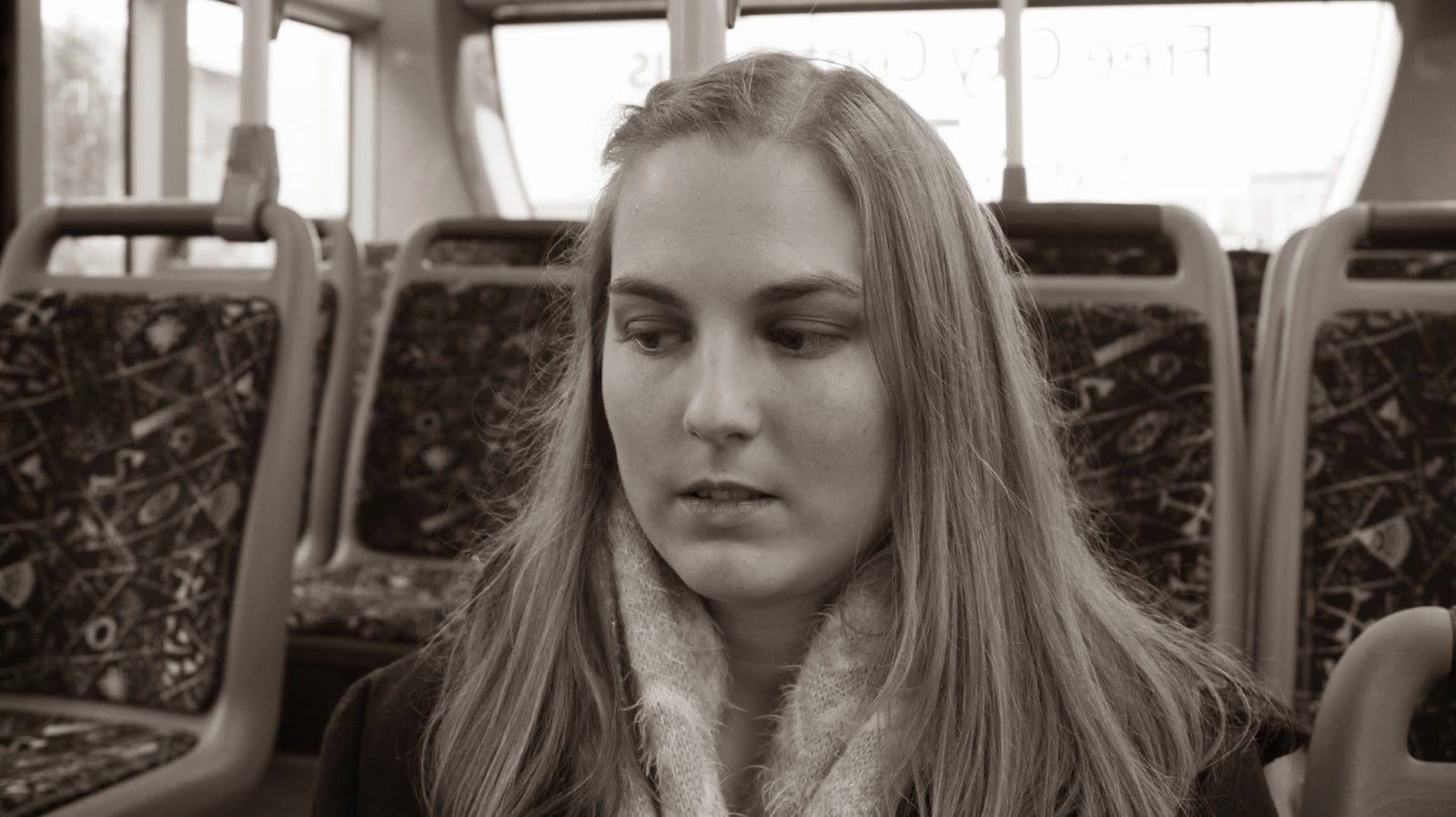
I did most of the editing for this project, which although
didn’t require any advance editing techniques it was time consuming and
difficult. For the most part all I had to do was decide how long each photo
would stay on screen for and which photos to use, this was relatively easy for
the start of the film as photos could linger for a while and there was one
character to deal with. As the film progressed and voices began overlapping it
became increasingly difficult for me to pick out which photo best suited the
dominate voice and which character’s photo should follow it.
Subscribe to:
Posts (Atom)